
How CeeGeeDFS works
From slate research
to purposeful lineups.
Understand the environment. Build your player pool. Connect the pieces. Use your research to shape every lineup you create.
Free during soft launch · DraftKings & FanDuel
An NFL walkthrough of a process you can use across DFS sports.
See the decisions behind the build.
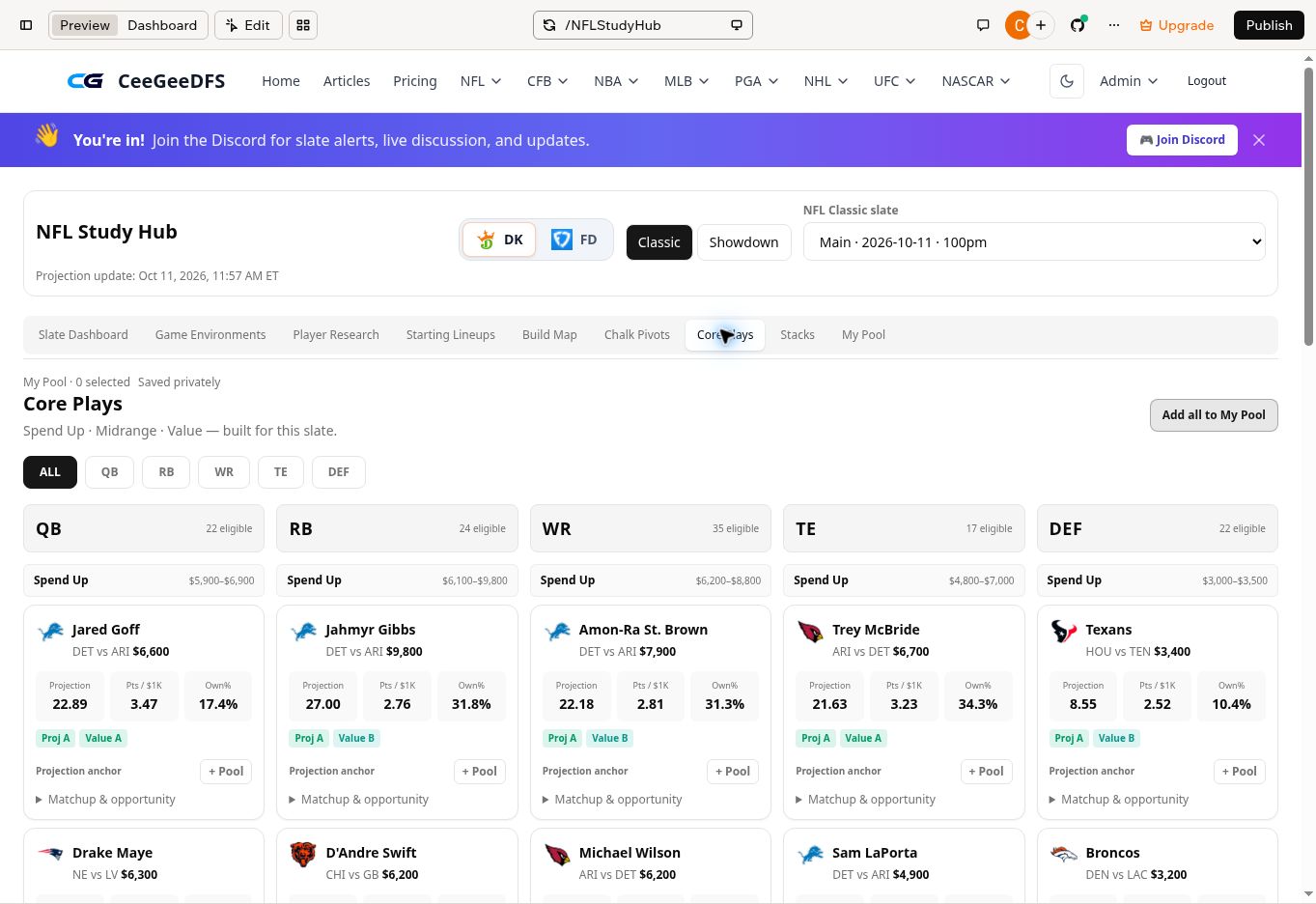
Actual CeeGeeDFS interface · historical slate example
Five steps. A clearer way to build.
Start with the decision, then use the tool that answers it. This example uses NFL Classic; available tools and roster rules vary by sport and contest format.
Start with the environment.
Game Environments + Slate Dashboard
Where does this slate create opportunity?
Compare scoring environments, team tendencies, and player opportunity before narrowing your pool. Then look at salary tiers and ownership pressure to understand which constructions the field will find easiest.
- Separate historical team tendencies from current slate projections.
- Compare games and the players who benefit from each scoring path.
- Identify where salary relief changes the rest of the roster.
A slate-level view of the games, opportunity, and salary decisions worth researching.
Give each player a role.
Projections + Player Research + Core Plays
What does this player contribute to my build?
Use projection and value as a starting point, then add ownership, matchup context, and opportunity. Core Plays organizes the conversation across positions and salary tiers; your research determines which profiles belong in your pool.
- Distinguish dependable cash profiles from tournament ceiling and volatility.
- Compare spend-up, midrange, and value options in the same roster context.
- Use My Pool to keep track of the players you want to research further.
A purposeful player pool with clear reasons for spending, saving, and differentiating.
Connect the pieces.
Stacks + Build Map + Chalk Pivots
How does this lineup reach its ceiling?
Compare complete combinations instead of evaluating every player in isolation. Stack size, bring-backs, salary commitment, and ownership all change what remains available for the rest of the roster.
- Compare quarterback stacks and bring-backs by salary and contest profile.
- Use Build Map to see the positional trade-offs around your stack.
- Evaluate Chalk Pivots as roster alternatives, with projection and ceiling context.
A construction with a coherent scoring path and intentional salary trade-offs.
Turn your research into rules.
NFL Optimizer · Beta
Do these settings express my strategy?
Use player preferences, exposure limits, groups, and stacking controls to translate your decisions into lineups. The optimizer applies your inputs; the strategic decisions still come from your research.
- Choose your platform, slate, and Classic or Showdown format.
- Use preferences to express conviction and caps to control concentration.
- Check that groups and stack rules allow the constructions you intended.
Candidate lineups built around your chosen player pool, correlations, and constraints.
Check the builds against the plan.
Lineup review + exposures + export
Did the portfolio express the strategy?
Review the complete lineups and exposure summaries before exporting. A strong player pool can still produce a portfolio that is too concentrated, repeats the same scoring path, or uses correlations differently than intended.
- Assess the complete roster, not just its highest-projected players.
- Compare player and stack exposure with the risk you intended to take.
- Use post-slate reviews to evaluate the reasoning behind the outcome.
A reviewed portfolio that matches your contest and your pre-lock decisions.
Your pre-export review
Try the checklist. It does not change optimizer settings.
Choose your sport
The questions carry over. The tools adapt.
In MLB and NHL, correlation centers on stacks. In PGA, UFC, and NASCAR, salary, ownership, ceiling, and volatility shape the construction. Use each sport’s available research tools; NFL and NBA have optimizer entry points.
Tool guides
Learn one tool at a time.
Start with NFL Projections: choose your slate, read the main columns, and compare players using real examples.
A few useful answers
Do I need to use every tool for every slate?
No. Start with the questions your slate presents. Use the relevant views to resolve those decisions, then move into construction and review.
Are Core Plays automatic lineup locks?
Core Plays gives you starting points across positions and salary tiers. Evaluate the profile, contest fit, and complete construction before deciding how to use a player.
Does the optimizer replace my research?
The optimizer builds from your inputs and constraints. Your research determines the player pool, correlations, preferences, and exposure limits that define the portfolio.
Are the screenshots showing today’s advice?
No. These are actual tool screenshots from the October 11, 2026 NFL Main slate, used to demonstrate the interface. Player values and visible settings are examples, not recommended settings or current slate advice.
What does access cost?
Access is free during the soft launch. See the access page for current membership details and available features.
View access detailsYour next slate starts here
Put the process to work.
Start with the research. Make the construction decisions. Review the lineup before it leaves the optimizer.